
Well-Baby Visit Schedule: Month-by-Month First Year Guide
Disclaimer: This article is for informational purposes only and should not replace professional medical advice. Consult your pediatrician before making any health decisions for your child.
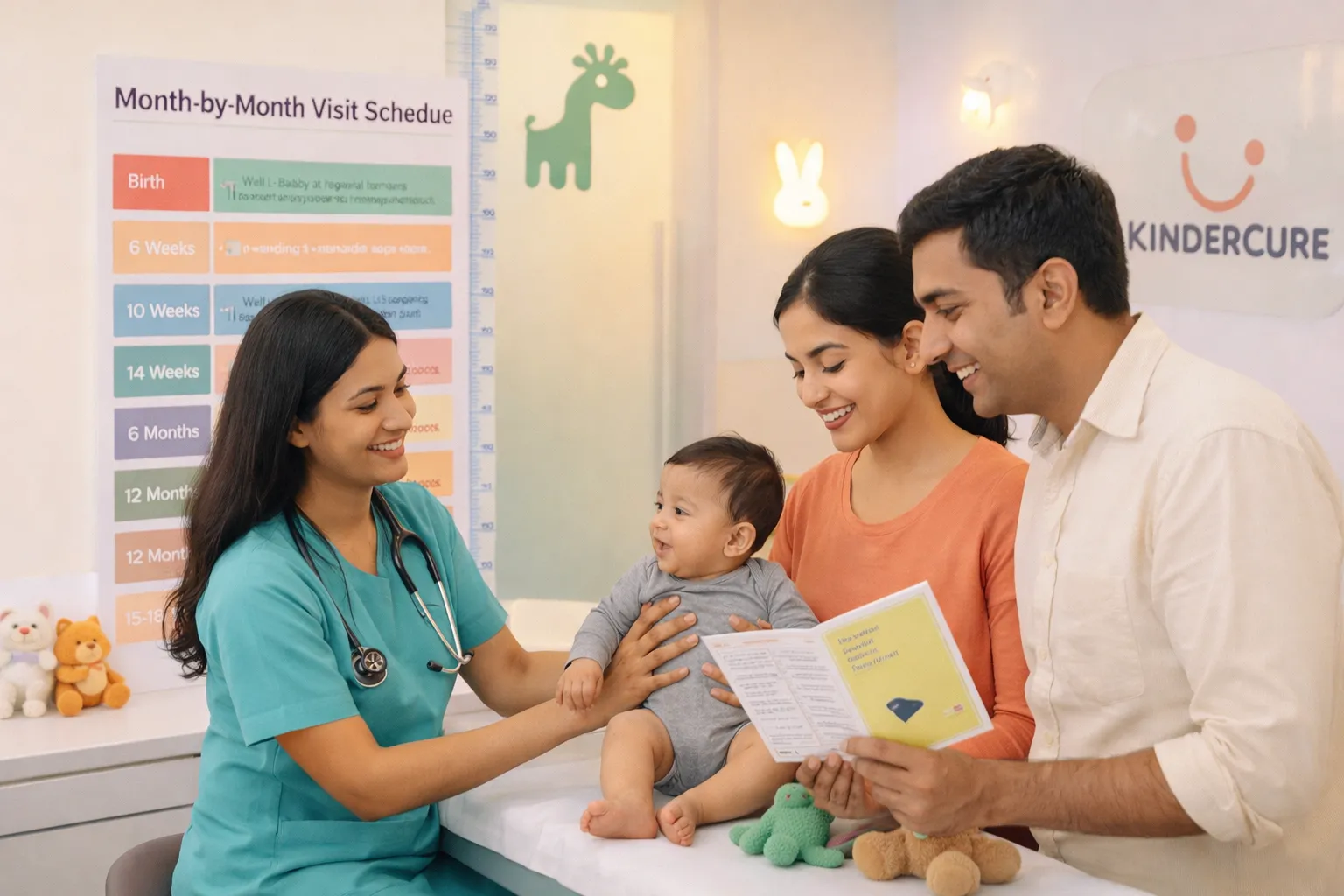
The first year of your baby's life is a period of remarkable growth and development. Regular well-baby visits are not just about vaccinations — they are your pediatrician's opportunity to monitor your child's physical growth, track developmental milestones, catch potential problems early, and answer your questions as a new parent.
"Well-baby visits are the foundation of preventive pediatric care. Every visit is an opportunity to identify issues early — when they are easiest to address — and to support parents through the most intensive year of their child's life." – Dr. Garima Mengi, KinderCure Clinic
Overview: When Are Well-Baby Visits Scheduled?
In the first year, the Indian Academy of Pediatrics (IAP) and most pediatricians recommend visits at:
| Age | Primary Purpose |
|---|---|
| Birth (Day 0-3) | Initial assessment, metabolic screening |
| 2 weeks | Weight check, feeding assessment |
| 6 weeks | First major vaccination round, growth review |
| 10 weeks | Second vaccination round |
| 14 weeks | Third vaccination round |
| 6 months | Mid-year assessment, solid food readiness |
| 9 months | Developmental screening, catch-up vaccines |
| 12 months | First birthday assessment, MMR vaccine |
Additional visits may be scheduled based on your baby's individual needs, and your pediatrician may recommend more frequent visits in the early weeks if there are feeding or weight concerns.
Month-by-Month Guide
Birth to 3 Days: The First Assessment
What happens:
- Complete physical examination — heart, lungs, abdomen, hips, reflexes, skin
- Assessment of feeding (breastfeeding initiation support)
- Newborn metabolic screening (Guthrie test / heel prick test) at 48-72 hours
- Newborn hearing screening (OAE or ABR test)
- Jaundice assessment (visual and/or bilirubin measurement)
- Birth weight and head circumference recorded as baseline
- vitamin K injection and hepatitis B birth dose
Vaccinations at birth:
- BCG (tuberculosis)
- OPV-0 (oral polio — zero dose)
- Hepatitis B — birth dose
What parents should track:
- Feeding frequency (at least 8-12 breastfeeds in 24 hours)
- Wet and dirty nappies (increasing daily in the first week)
- Skin colour — watch for increasing yellowness (jaundice)
2 Weeks: The First Post-Discharge Check
What happens:
- Weight check — baby should be back to or approaching birth weight
- Feeding assessment — breastfeeding evaluation, latch check
- Jaundice follow-up if indicated
- Umbilical cord stump check
- Discussion of feeding patterns, sleep, and parental concerns
- Review of metabolic screening results
Key milestones to observe:
- Baby can briefly focus on faces at close range (20-30 cm)
- Startles to loud sounds (Moro reflex)
- Flexed posture with limbs tucked close to body
"The 2-week visit is particularly important for first-time parents. It is an opportunity to address feeding concerns early — before they become entrenched problems." – Dr. Garima Mengi
6 Weeks: The First Major Vaccination Visit
What happens:
- Growth measurements — weight, length, head circumference plotted on growth charts
- Complete physical examination
- First major round of vaccinations
- Developmental assessment — early reflexes, visual tracking, social smile
Vaccinations at 6 weeks (IAP Schedule 2024-25):
- DTwP/DTaP-1 (diphtheria, tetanus, pertussis)
- IPV-1 (injectable polio)
- Hib-1 (Haemophilus influenzae type b)
- Hepatitis B-2
- Rotavirus-1
- PCV-1 (pneumococcal conjugate vaccine)
Key milestones:
- Social smile (responding to faces)
- Briefly lifting head during tummy time
- Tracking objects with eyes
- Cooing sounds beginning
What parents should discuss:
- Feeding routine — is baby settling into a pattern?
- Sleep patterns — safe sleep practices
- Tummy time — are you providing supervised tummy time daily?
10 Weeks: Second Vaccination Round
What happens:
- Growth monitoring — weight gain trajectory
- Vaccination round 2
- Brief developmental check
Vaccinations at 10 weeks:
- DTwP/DTaP-2
- IPV-2
- Hib-2
- Hepatitis B-3
- Rotavirus-2
- PCV-2
Key milestones:
- Head control improving during tummy time
- Increased social engagement — smiling, cooing in response to voices
- Beginning to bring hands together at midline
- Tracking objects more smoothly
14 Weeks: Third Vaccination Round
What happens:
- Growth monitoring
- Vaccination round 3
- Developmental assessment
Vaccinations at 14 weeks:
- DTwP/DTaP-3
- IPV-3
- Hib-3
- Hepatitis B-4
- Rotavirus-3
- PCV-3
Key milestones:
- Good head control when supported in sitting
- Reaching for objects
- Laughing and vocalising more
- Rolling from tummy to back may begin
6 Months: The Mid-Year Assessment
This is a significant visit — it marks the transition from exclusive breastfeeding/formula to the introduction of complementary foods.
What happens:
- Comprehensive growth assessment — weight, length, head circumference
- Detailed developmental screening
- Discussion of solid food introduction — what, when, how
- Oral health check (teeth may be emerging)
- Vaccinations
- Vision and hearing informal assessment
Vaccinations at 6 months:
- OPV-1 (oral polio booster)
- Influenza vaccine — first dose (recommended by IAP)
- Typhoid conjugate vaccine (TCV) — recommended by IAP (typically given between 6-9 months)
Key milestones:
- Sitting with support, may sit briefly without support
- Transferring objects between hands
- Babbling with consonant sounds ("ba," "da," "ma")
- Stranger anxiety may begin
- Reaching for and grasping objects purposefully
- Showing interest in food
Solid food readiness signs:
- Can sit with minimal support
- Good head and neck control
- Shows interest in food (watching you eat, reaching for food)
- Loss of tongue-thrust reflex (does not push food out of mouth)
- Can bring objects to mouth
9 Months: Developmental Screening
What happens:
- Growth monitoring
- Formal developmental assessment — motor, language, social, cognitive
- Catch-up vaccinations if any were missed
- Discussion of sleep, feeding progression, safety (baby-proofing)
Vaccinations at 9 months:
- OPV-2
- MMR-1 (measles, mumps, rubella) — or Measles standalone if MMR is given at 12 months
- Influenza-2 (second dose, given 4 weeks after first if started at 6 months)
- MCV-1 (meningococcal conjugate vaccine — optional, recommended by IAP)
Key milestones:
- Crawling or bottom-shuffling
- Pulling to stand
- Pincer grasp (picking up small objects with thumb and forefinger)
- Responding to own name
- "Mama" and "Dada" (may be non-specific)
- Waving bye-bye
- Object permanence (looking for hidden objects)
"The 9-month developmental screening is a critical checkpoint. It helps us identify early signs of developmental delay when intervention is most effective." – Dr. Garima Mengi
12 Months: The First Birthday Assessment
What happens:
- Comprehensive growth assessment — weight, length, head circumference plotted against WHO growth curves
- Full developmental screening
- Vaccination updates
- Discussion of transitioning from breast/formula to whole milk
- Dental health — first dental visit recommended around this time
- Safety review (toddler-proofing as baby becomes mobile)
Vaccinations at 12 months:
- Hepatitis A-1
- PCV Booster
- MMR-1 (if not given at 9 months)
- MCV-2 (meningococcal conjugate vaccine — optional)
Varicella-1 (chickenpox) is typically given at 15 months and will be covered at a subsequent visit.
Key milestones:
- Standing independently, may take first steps
- Using 1-3 words meaningfully
- Following simple instructions ("Give me the ball")
- Using gestures (pointing, waving)
- Eating a variety of finger foods
- Drinking from a cup with assistance
Growth Tracking: What Your Pediatrician Measures
At every well-baby visit, three key measurements are plotted on standardised growth charts:
- Weight: The most sensitive indicator of nutritional status. Expected to double by 5 months and triple by 12 months
- Length/Height: Reflects long-term nutritional status and genetic potential
- Head circumference: Reflects brain growth. Rapid or slow growth may warrant further investigation
For a detailed guide on reading and understanding growth charts, see our article on baby growth charts and developmental milestones.
When to Be Concerned
- Weight falling across two or more percentile lines on the growth chart
- Head circumference increasing too rapidly or too slowly
- Length consistently below the 3rd percentile
- Failure to regain birth weight by 2 weeks
Your pediatrician at KinderCure uses growth monitoring services to track trends over time — a single measurement is less meaningful than the overall pattern.
Vaccination Schedule at a Glance (IAP 2024-25)
| Age | Vaccines |
|---|---|
| Birth | BCG, OPV-0, Hep B-1 |
| 6 weeks | DTwP/DTaP-1, IPV-1, Hib-1, Hep B-2, Rotavirus-1, PCV-1 |
| 10 weeks | DTwP/DTaP-2, IPV-2, Hib-2, Hep B-3, Rotavirus-2, PCV-2 |
| 14 weeks | DTwP/DTaP-3, IPV-3, Hib-3, Hep B-4, Rotavirus-3, PCV-3 |
| 6 months | OPV-1, Influenza-1, TCV |
| 9 months | OPV-2, MMR-1/Measles, Influenza-2, MCV-1 (optional) |
| 12 months | Hep A-1, PCV Booster, MMR-1 (if not at 9 months), MCV-2 (optional) |
For the complete vaccination programme including optional and booster doses, visit our child vaccination page.
Preparing for Well-Baby Visits
What to Bring
- Vaccination record book
- A list of questions or concerns
- Notes on feeding, sleep, and nappy patterns
- A change of clothes and nappies for baby
Questions Worth Asking
- Is my baby growing at the expected rate?
- Are developmental milestones being met on schedule?
- Are there any concerns from today's examination?
- When is the next vaccination due?
- What safety measures should I implement at this stage?
- Are there any nutritional changes I should make?
Book Your Baby's Next Check-Up
Regular well-baby visits are the best way to ensure your child is growing, developing, and thriving. At KinderCure Clinic, Dr. Garima Mengi provides comprehensive well-baby visit services that combine growth monitoring, developmental screening, and vaccination in a single, thorough appointment. Schedule your baby's visit today.
Frequently Asked Questions
What if my baby is sick on the day of a scheduled visit?
Mild illness (a runny nose without fever) usually does not require rescheduling. However, if your baby has a fever, is vomiting, or appears significantly unwell, it is better to reschedule. Vaccinations can generally be given during mild illness, but your pediatrician will assess and advise.
Can I combine well-baby visits with vaccination appointments?
Yes, and this is how most pediatricians structure care. Well-baby visits are designed to coincide with the vaccination schedule, so your baby receives a full health check alongside immunisations at each visit.
How long does a typical well-baby visit take?
A routine well-baby visit at KinderCure typically takes 20-30 minutes. The first visit and the 6-month and 12-month assessments may take longer due to more comprehensive developmental screening.
What if I miss a scheduled visit?
Schedule a make-up appointment as soon as possible. Missed vaccinations can be caught up according to your pediatrician's guidance. Growth and developmental monitoring is most valuable when consistent, but a delayed visit is always better than a skipped one.
Do I need to visit the pediatrician if my baby seems perfectly healthy?
Yes. Well-baby visits are preventive care — their purpose is to catch issues before symptoms appear. Many developmental concerns, growth problems, and health conditions are identified during routine check-ups in babies who appear outwardly healthy.
Is the well-baby visit schedule different for premature babies?
Premature babies may need more frequent visits, especially in the first few months. Your pediatrician will create a customised schedule based on your baby's gestational age and individual needs. Developmental milestones for premature babies are assessed using corrected age (adjusted for prematurity) until 2 years.
What is the cost of well-baby visits in India?
Consultation fees vary by city and clinic. At KinderCure in Gurgaon, well-baby visits include a comprehensive examination, growth plotting, and developmental assessment. Vaccination costs are separate and depend on the vaccine type (some are included in government programmes). Contact KinderCure at +91-7678252448 for detailed pricing information.
Related Articles
- Well-Baby Visits at KinderCure
- Complete Child Vaccination Guide
- Understanding Growth Charts
- Developmental Assessment Services
References
[1] Indian Academy of Pediatrics. "IAP Immunization Schedule 2024-25." Indian Pediatrics, 2024.
[2] World Health Organization. "Child Growth Standards." WHO, 2006.
[3] Palpallatoc CS, Palpallatoc RDG. "Well-Child Visits." StatPearls, National Library of Medicine, 2023.
Related Articles


Comprehensive Newborn Care
Expert newborn care and guidance for new parents.