
Tackling Childhood Obesity: A Holistic Approach to Healthy Growth
Disclaimer: This blog is for informational purposes only and is not a substitute for professional medical advice.
Childhood obesity in India is a growing health concern. According to a landmark global analysis, approximately 12.5 million Indian children and adolescents aged 5–19 were living with obesity as of 2016 [1] — a figure projected to rise to 27 million by 2030 [2]. India faces a unique "double burden" of malnutrition: undernutrition and overnutrition exist simultaneously, often across different economic groups within the same city [1]. As of 2020, an estimated 33 million Indian children were overweight or obese, with the prevalence growing at 6.2% annually [3]. At KinderCure, we address this challenge head-on, adopting a holistic approach to promote healthy growth in children.
The Rising Trend of Childhood Obesity in India
The Numbers
The scale of the problem is significant and accelerating. A pooled meta-analysis of Indian data found that 8.4% of school-age children were obese and 12.4% were overweight [3]. Among urban schoolchildren, the prevalence of overweight reaches as high as 19.3%, with children attending private schools at consistently higher risk than those in government schools [3]. Boys in the Indian population appear to be at higher risk than girls [3]. Perhaps the most concerning statistic is this: more than 80% of obese adolescents go on to become obese adults, carrying the associated health risks with them for life.
Why It's Happening
India is experiencing what nutritionists call a "nutrition transition" — a shift from traditional Indian diets built around dal, sabzi, roti, and seasonal fruit to ultra-processed foods high in refined sugar, salt, and unhealthy fats. This transition is most pronounced in urban centres like Gurgaon, where fast food chains, packaged snacks, and sugary beverages are readily available and heavily marketed to children.
At the same time, physical activity among children has declined sharply. Urban Indian children average 3.9 hours of daily screen time — well above recommended limits. Outdoor play in urban India has declined by over 40% in the last decade, driven by a combination of shrinking play spaces, safety concerns, and the demands of school plus tuition schedules. In cities like Gurgaon, a child's day is often packed with school, coaching classes, and homework, leaving virtually no time for unstructured physical activity. Private school canteens have been identified as higher-risk food environments, where processed options frequently dominate the menu [3].
How Is Childhood Obesity Diagnosed?
Children cannot be judged by adult BMI standards. A child's body composition changes substantially with age, which is why paediatricians use BMI-for-age charts rather than a single number.
- Under 5 years: Weight-for-length or weight-for-height is plotted using WHO growth standards
- Ages 5–18: BMI is plotted on IAP 2015 growth charts, which are India-specific and differ from the WHO charts used internationally
On these charts, a child at the 85th percentile is classified as overweight, and a child at the 95th percentile is classified as obese. These thresholds matter because Indian children face cardiometabolic risk at lower BMI thresholds than Western populations [3] — a child who appears "normal" by global standards may already be developing insulin resistance, lipid abnormalities, or early fatty liver changes.
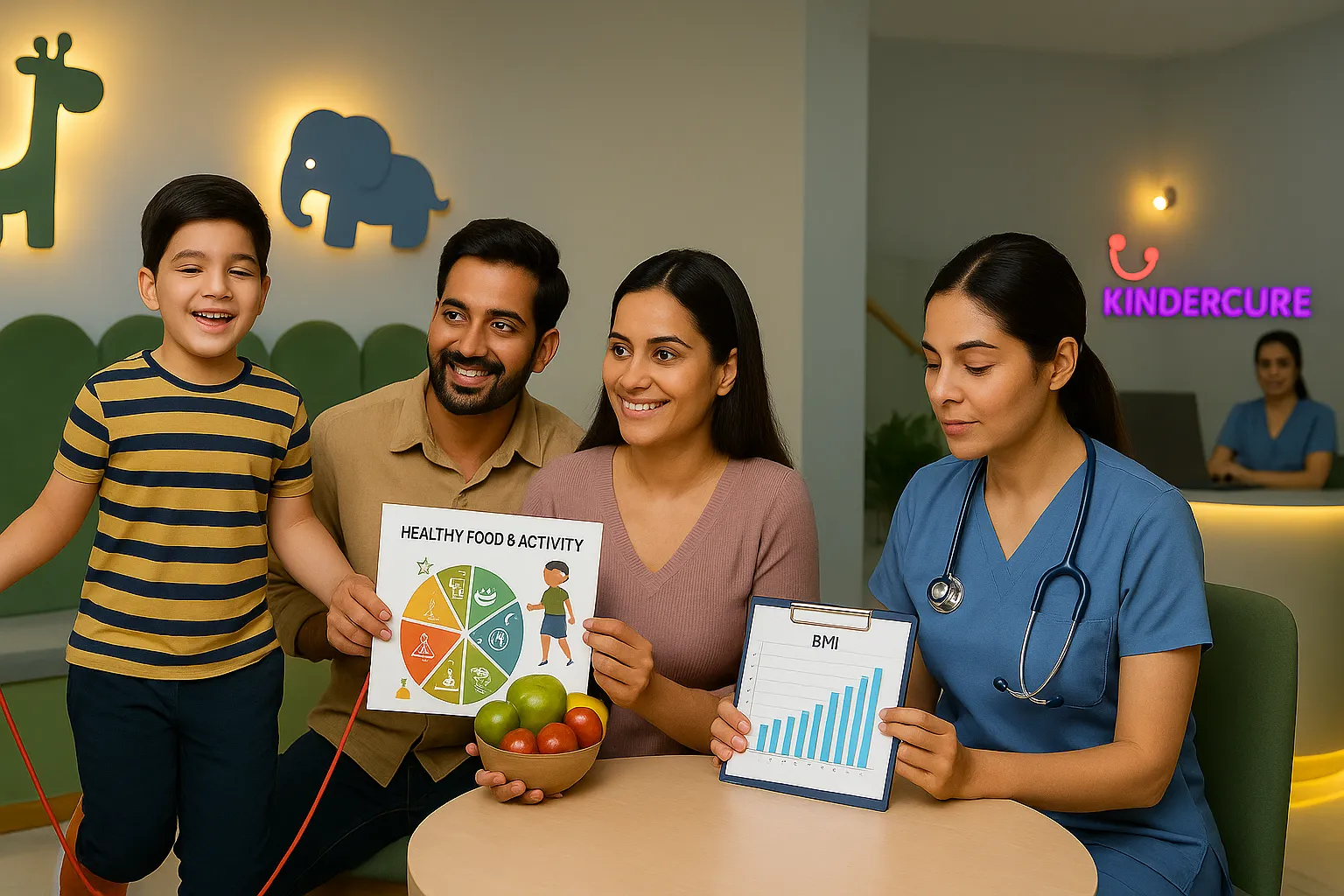
Our growth monitoring services include regular BMI tracking using IAP-recommended charts, helping detect concerning trends early — often before the problem becomes visible to parents.
Health Implications and Psychological Effects
Physical Health Risks
Obesity in childhood is no longer just a cosmetic or lifestyle concern — it is a medical condition with serious consequences. Children with obesity are at significantly elevated risk for [3]:
- Type 2 diabetes: Insulin resistance often develops before the teenage years, particularly in Indian children who carry genetic susceptibility
- Hypertension: High blood pressure, once considered an adult disease, is increasingly detected in obese children during routine check-ups
- Lipid abnormalities: Elevated cholesterol and triglycerides that accelerate cardiovascular damage
- Non-alcoholic fatty liver disease (NAFLD): Now one of the most common liver conditions in obese children
- Polycystic ovarian syndrome (PCOS): Increasingly diagnosed in adolescent girls with obesity, affecting menstrual regularity, skin health, and future fertility
These are no longer "adult diseases." They are increasingly common in Indian children, and their early onset means longer exposure to damage — making childhood intervention far more impactful than waiting until adulthood.
Psychological Impact
The psychological consequences of childhood obesity are substantial and well-documented. A systematic review of 53 studies confirms that obese children carry significantly higher rates of depression, anxiety, and behavioural disorders compared to their healthy-weight peers [4].
- Bullying and social exclusion are pervasive experiences for overweight children, particularly in school settings
- Body image dissatisfaction creates a dangerous bidirectional cycle: emotional distress triggers comfort eating, which worsens obesity, which deepens distress [4]
- Low self-esteem and poor school performance are documented consequences, with obese children frequently withdrawing from social and physical activities
- Secretive eating behaviours often develop as children learn to hide their food consumption from parents and peers
The psychological burden is not secondary to the physical one — it is equally urgent and often the aspect that affects a child's daily quality of life most directly.
Screen Time and Sedentary Behaviour
Excessive screen time is both a cause and a consequence of childhood obesity. The WHO provides clear guidelines on screen time for children:
- Under 2 years: No screen time at all
- Ages 2–5: Maximum 1 hour per day
- Ages 6 and above: Consistent limits with regular breaks for physical activity
Research shows that children snack 2.5 times more during screen-based activities compared to non-screen time — a combination of mindless eating, exposure to food advertising, and displacement of active play. Here are practical steps families can take:
- No eating in front of screens — this single rule can meaningfully reduce calorie intake
- Structured meal times as a family — eating together at a table promotes mindful eating and portion awareness
- Replace 30 minutes of screen time with outdoor play daily — start small and build the habit gradually
- Remove screens from bedrooms — this protects sleep quality and reduces late-night snacking
For more on managing screen time, see our article on managing screen time for healthy minds.
The Role of Regular Check-Ups at KinderCure
Regular paediatric check-ups at KinderCure are crucial. During these visits, we assess your child's growth patterns, dietary habits, and physical activity levels through our comprehensive growth monitoring services. This allows us to provide personalised advice and early intervention strategies tailored to your child's specific needs.
Success Stories from KinderCure
We've seen remarkable success in managing childhood obesity. Take, for instance, the case of 10-year-old Riya, who, with our guidance, successfully adopted a healthier lifestyle, resulting in improved physical and emotional health.
Our Comprehensive Strategies
At KinderCure, our strategies include:
- Nutrition Education: Teaching families about balanced diets and healthy food choices through our specialised child nutrition guidance services.
- Promoting Physical Activity: Encouraging regular exercise tailored to each child's interests.
- Psychological Support: Addressing emotional factors related to eating and body image.
Beyond these core strategies, we recommend several India-specific approaches that families can adopt immediately:
- Tiffin box over canteen: Pack balanced meals — roti with sabzi, dal rice, a portion of fruit — rather than relying on school canteens where processed options dominate [3]. A well-planned tiffin box is one of the most effective daily interventions a parent can make.
- FSSAI awareness: FSSAI regulations ban junk food sale on school premises and within 50 metres. Parents can and should advocate for enforcement at their child's school — many schools are unaware of or non-compliant with these guidelines.
- Family activity: Even a 30-minute family walk after dinner can make a meaningful difference when done consistently. The key word is family — children are far more likely to be active when their parents are active alongside them.
- Festive food awareness: Diwali, Holi, and birthday parties are high-calorie events. Plan ahead rather than restricting on the day — allow your child to enjoy celebrations while ensuring the overall week remains balanced.
For more on building healthy eating habits, see our article on encouraging healthy eating habits in children.
Dr. Garima Mengi's Perspective
"Addressing childhood obesity is not just about weight; it's about setting foundations for a healthy, happy life. Our aim at KinderCure is to empower families with knowledge and support."
When to Seek Professional Help
Not every child who looks chubby needs medical intervention. Many children carry extra weight during growth spurts and naturally slim down as they grow taller. However, consult a paediatrician if you notice:
- BMI consistently at or above the 85th percentile for age and sex on IAP growth charts
- Darkened, velvety skin patches on the neck or armpits — this is called acanthosis nigricans and is an early sign of insulin resistance that many Indian parents notice but do not recognise as medically significant
- Snoring or breathing pauses during sleep — possible obstructive sleep apnoea, which is more common in obese children
- Fatigue or shortness of breath during mild physical activity that peers manage without difficulty
- Night eating or secretive eating behaviours — these suggest an emotional component that needs professional support
- Family history of type 2 diabetes, hypertension, or cardiovascular disease — genetic predisposition combined with excess weight significantly amplifies risk
Early intervention protects both physical and mental health. Our paediatric consultations and growth monitoring services can help assess your child's risk and create a personalised plan.
Take a Step Towards Healthier Childhoods
Concerned about your child's health? Join the many families who have found success with KinderCure's holistic approach to managing childhood obesity.
Ready to Start Your Child's Journey to Better Health?
Schedule an appointment at KinderCure Clinic or through WhatsApp to get personalised guidance for your child's health and nutrition.
Frequently Asked Questions
Is my child just "healthy" or actually overweight?
The only reliable way to know is BMI-for-age plotted on IAP growth charts. A child who looks "healthy" by family standards may already be above the 85th percentile. Indian families often normalise higher body weight in children as a sign of good health, but the metabolic reality can be different — particularly given that Indian children face cardiometabolic risk at lower BMI thresholds than Western populations [3]. Ask your paediatrician to plot your child's BMI at the next visit.
Should I put my child on a diet?
Restrictive dieting is not recommended for growing children. Instead, focus on improving food quality — more dal, sabzi, and fruit; fewer packaged snacks and sugary drinks — and increasing physical activity. The goal for most children is to "grow into" their weight as they get taller, rather than actively losing weight. Crash diets can deprive children of essential nutrients during critical growth periods and may trigger disordered eating patterns [4].
How much physical activity does my child need daily?
The WHO recommends at least 60 minutes of moderate-to-vigorous physical activity daily for children aged 5–17. This includes active play, sports, cycling, or even brisk walking. Structured exercise is not necessary — unstructured outdoor play counts and is often more sustainable. The challenge in cities like Gurgaon is finding the time and space, but even breaking the 60 minutes into shorter bouts throughout the day is effective.
Can childhood obesity be reversed?
Yes, especially when addressed early. With consistent changes to diet quality, physical activity, screen time, and family habits, many children achieve a healthy weight trajectory. The Riya case study above illustrates this. The key is a whole-family approach rather than singling out the child — when the entire household adopts healthier habits, the child benefits without feeling targeted or ashamed.
What are the darkened patches on my child's neck?
Darkened, velvety patches on the neck, armpits, or groin are called acanthosis nigricans. They are a visible sign of insulin resistance — the body is producing excess insulin to manage blood sugar. This is not a skin condition that can be scrubbed away; it is a metabolic signal that warrants a paediatric consultation. Many Indian parents first notice these patches and assume they are caused by friction or poor hygiene, delaying medical evaluation.
Does screen time actually cause weight gain?
Screen time contributes to weight gain through multiple pathways: it displaces physical activity, disrupts sleep, exposes children to food advertising, and increases mindless snacking. Children snack 2.5 times more while watching screens. A systematic review confirms that obese children also experience higher rates of depression and anxiety [4], and excessive screen time worsens both. Reducing screen time is one of the most impactful single changes a family can make.
References
[1] NCD Risk Factor Collaboration (NCD-RisC). (2017). Worldwide trends in body-mass index, underweight, overweight, and obesity from 1975 to 2016. The Lancet, 390(10113), 2627-2642. Link
[2] UNICEF India. (2024). India: Overweight and obesity rising across all ages — from youngest children to adults. Link
[3] Kapoor, N., et al. (2024). Tackling the Rising Tide: Understanding the Prevalence of Childhood Obesity in India. Indian Journal of Endocrinology and Metabolism, 28(2). Link
[4] Rankin, J., et al. (2016). Psychological consequences of childhood obesity: psychiatric comorbidity and prevention. Adolescent Health, Medicine and Therapeutics, 7, 125-146. Link
Related Articles
- Encouraging Healthy Eating Habits in Children: Practical Tips and Success Stories
- Navigating the Challenges of Picky Eaters: Strategies for Parents
- Understanding the Importance of Early Childhood Nutrition
- The Importance of Play in Child Development: A Paediatric Perspective
Internal Links
Related Articles


Need Expert Pediatric Care?
Book an appointment with Dr. Garima Mengi at KinderCure for personalized pediatric healthcare.