
Newborn Hearing Screening: What to Expect and Why It Matters
Disclaimer: This article is for informational purposes only and should not replace professional medical advice. Consult your pediatrician before making any health decisions for your child.
Hearing is essential for speech, language, and cognitive development — and hearing loss in newborns is more common than most parents realise. Approximately 1 to 3 in every 1,000 babies are born with significant hearing loss in one or both ears [1]. Without screening, hearing loss often goes undetected until age 2 or later, by which time critical windows for language development have been missed.
Newborn hearing screening is a quick, painless test that can identify potential hearing issues within the first days of life, allowing early intervention that fundamentally changes outcomes.
"A child identified with hearing loss by 3 months and receiving intervention by 6 months develops language skills comparable to their hearing peers. That is the power of early screening." – Dr. Garima Mengi, KinderCure Clinic
Why Newborn Hearing Screening Matters
The Critical Window for Language Development
The first three years of life are the most intensive period for speech and language acquisition. During this time, the brain is building the neural pathways that will support communication for life. Hearing loss during this period has cascading effects:
- Language delay: Children with undetected hearing loss develop language 1-4 years behind their peers
- Academic impact: Untreated hearing loss is associated with lower reading scores and reduced academic achievement
- Social-emotional effects: Communication difficulties can lead to social isolation, frustration, and behavioural challenges
- Cognitive development: Hearing provides a continuous stream of incidental learning — conversations, environmental sounds, storytelling — that profoundly shapes cognitive development
The Evidence for Early Detection
Research consistently shows that early identification and intervention lead to dramatically better outcomes [2]:
- Children identified by 6 months develop vocabulary and language skills within normal range by school age
- Children identified after 6 months show significant language delays that persist through childhood
- Every month of delay in identification correlates with measurable reduction in language outcomes
Risk Factors for Newborn Hearing Loss
While hearing screening should be performed on all newborns regardless of risk factors, certain babies are at higher risk:
- Family history of permanent childhood hearing loss
- NICU stay of more than 5 days
- Hyperbilirubinemia (high jaundice) requiring exchange transfusion
- Congenital infections (TORCH — toxoplasmosis, rubella, cytomegalovirus, herpes)
- Craniofacial anomalies affecting the ear
- Low birth weight (less than 1,500 grams)
- Low Apgar scores (0-4 at 1 minute or 0-6 at 5 minutes)
- Mechanical ventilation for more than 5 days
- Exposure to ototoxic medications (gentamicin, furosemide)
- Syndromes associated with hearing loss (Down syndrome, Waardenburg syndrome)
Types of Newborn Hearing Tests
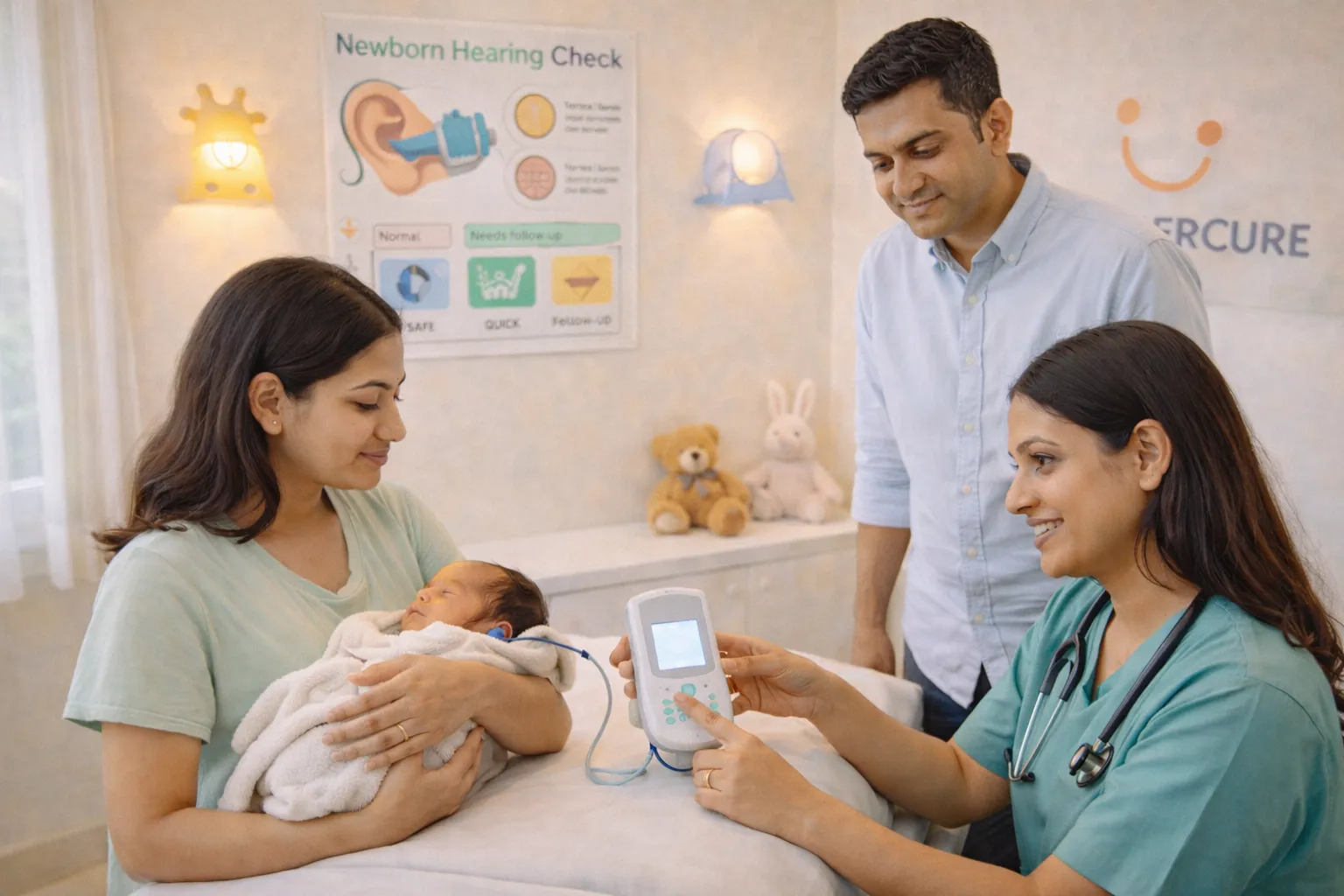
Two primary screening technologies are used, both painless and typically performed while the baby is sleeping.
Otoacoustic Emissions (OAE)
How it works: A small, soft-tipped probe is placed in the baby's ear canal. The probe emits quiet clicking sounds (stimuli) and a sensitive microphone within the probe records the echoes (otoacoustic emissions) produced by the outer hair cells of the inner ear (cochlea).
What it measures:
- The function of the outer hair cells in the cochlea
- A healthy inner ear produces measurable echoes in response to sound
- Absence or reduced emissions suggests possible hearing loss
Advantages:
- Quick — typically 5-10 minutes for both ears
- Non-invasive and painless
- No electrodes needed
- Can be performed at bedside
Limitations:
- Can be affected by fluid or debris in the ear canal (common in newborns)
- Does not test the entire auditory pathway (only up to the cochlea)
- Cannot detect auditory neuropathy spectrum disorder (ANSD)
Auditory Brainstem Response (ABR)
How it works: Small electrodes (stickers) are placed on the baby's head and behind each ear. Headphones or ear inserts deliver clicking sounds, and the electrodes measure the electrical activity in the auditory nerve and brainstem in response to these sounds.
What it measures:
- The entire auditory pathway from the ear to the brainstem
- Whether the auditory nerve is transmitting signals correctly
- Can estimate hearing threshold levels
Advantages:
- Tests the complete auditory pathway
- Can detect auditory neuropathy spectrum disorder
- Provides more detailed diagnostic information
- Can estimate hearing levels if used in diagnostic mode
Limitations:
- Takes longer (15-30 minutes per ear in diagnostic mode)
- Requires the baby to be still or sleeping
- Electrode placement needed (painless but requires preparation)
Which Test Will My Baby Receive?
- Most hospital screening programmes use OAE as the initial screen due to its speed and simplicity
- ABR is used as a follow-up if OAE results are inconclusive, or as the primary screen for high-risk babies (NICU graduates)
- Some programmes use a two-stage protocol: OAE first, then ABR if OAE does not pass
- At KinderCure, we offer both OAE and ABR testing through our hearing test service
When Is Hearing Screening Done?
Recommended Timeline
- Before hospital discharge: Ideally within 24-48 hours of birth
- By 1 month of age: If not screened before discharge (home births, early discharge)
- By 3 months: Diagnostic evaluation completed for babies who do not pass the initial screen
- By 6 months: Intervention (hearing aids, therapy) initiated for confirmed hearing loss
This is known as the 1-3-6 guideline — screen by 1 month, diagnose by 3 months, intervene by 6 months.
Hearing Screening in India
India does not yet have a universal newborn hearing screening mandate, though the Rashtriya Bal Swasthya Karyakram (RBSK) — the national child health screening programme — includes hearing screening. Coverage varies:
- Major private hospitals in metros typically offer screening at birth
- Government hospitals have expanded screening but availability is inconsistent
- Many babies, especially those born at home or in smaller facilities, miss the screening window
If your baby was not screened at birth, you can arrange a hearing test at your pediatrician's office or a diagnostic audiology centre.
Understanding Screening Results
"Pass" (Also Called "Refer Negative")
A "pass" result means your baby's hearing appears normal at the time of testing. Both ears showed appropriate responses to the screening stimuli.
What to know:
- A pass does not guarantee normal hearing for life — some hearing loss develops later (progressive or late-onset hearing loss)
- Continue monitoring hearing milestones as your baby grows
- Report any concerns about hearing or speech development to your pediatrician
"Refer" (Also Called "Did Not Pass" or "Refer Positive")
A "refer" result means the test did not detect a clear response in one or both ears. This does not necessarily mean your baby has hearing loss.
Common reasons for a refer result that are not hearing loss:
- Fluid or vernix in the ear canal (extremely common in the first 48 hours)
- Baby was restless or crying during the test
- Background noise in the testing environment
- Equipment issues
What happens next:
- A repeat screen is recommended within 1-2 weeks
- If the repeat screen also returns a "refer" result, diagnostic ABR testing is arranged
- Approximately 90-95% of babies who "refer" on the initial screen will pass on repeat testing [3]
"A 'refer' result on the first screening test is not a diagnosis of hearing loss. It is a signal to test again. I always reassure parents that the vast majority of babies who refer initially have normal hearing." – Dr. Garima Mengi
Diagnostic ABR Results
If a baby does not pass the repeat screening, a diagnostic ABR is performed by an audiologist. This provides:
- Hearing threshold levels for each ear
- Type of hearing loss (conductive, sensorineural, or mixed)
- Severity (mild, moderate, severe, profound)
- Whether auditory neuropathy spectrum disorder is present
What If Hearing Loss Is Confirmed?
A diagnosis of hearing loss is understandably distressing for parents. However, with current technology and early intervention, children with hearing loss can develop excellent communication skills.
Types of Hearing Loss
Conductive hearing loss: Sound is blocked from reaching the inner ear (due to fluid, infection, or structural issues in the outer or middle ear). Often treatable with medical or surgical intervention.
Sensorineural hearing loss: Damage to the inner ear (cochlea) or auditory nerve. Usually permanent but manageable with hearing aids or cochlear implants.
Mixed hearing loss: A combination of conductive and sensorineural components.
Auditory neuropathy spectrum disorder (ANSD): The inner ear detects sound normally, but the signal is not transmitted properly to the brain. Requires specialised management.
Intervention Options
- Hearing aids: For mild to severe hearing loss. Modern pediatric hearing aids are small, powerful, and designed for infants
- Cochlear implants: For severe to profound hearing loss when hearing aids provide insufficient benefit. Most effective when implanted before 12-18 months
- Speech-language therapy: Essential alongside any hearing device. Early intervention programmes focus on auditory-verbal development
- Sign language: Some families choose sign language alongside spoken language (bimodal bilingual approach)
- FM systems: Wireless systems that improve signal-to-noise ratio, particularly useful in noisy environments
The Role of Early Intervention
Babies identified with hearing loss by 3 months and enrolled in intervention by 6 months achieve:
- Age-appropriate language skills by kindergarten
- Better reading and academic performance
- Stronger social skills and peer relationships
- Improved cognitive development
Monitoring Hearing as Your Child Grows
Even if your baby passes the newborn hearing screen, hearing should be monitored at regular well-baby visits and developmental assessments. Late-onset or progressive hearing loss can occur due to:
- Genetic conditions that cause delayed hearing loss
- Recurrent ear infections
- Ototoxic medications
- Head trauma
- Noise exposure
Hearing Milestones to Watch
| Age | Expected Response |
|---|---|
| 0-3 months | Startles to loud sounds, calms to familiar voices |
| 4-6 months | Turns head toward sounds, responds to name |
| 7-9 months | Responds to "no," turns to locate soft sounds |
| 10-12 months | Follows simple verbal commands, babbles with varied sounds |
| 12-18 months | Speaks first words, responds to questions |
| 18-24 months | Follows two-step commands, vocabulary expanding rapidly |
If your child is not meeting these milestones, discuss your concerns with your pediatrician and arrange a hearing evaluation.
Book a Hearing Test
Whether your newborn needs a first hearing screen, a repeat test, or you have concerns about your older child's hearing, KinderCure Clinic offers comprehensive hearing testing with expert evaluation by Dr. Garima Mengi. Book an appointment today.
Frequently Asked Questions
Is the hearing screening test painful for my baby?
No. Both OAE and ABR are completely painless. OAE involves placing a small, soft probe in the ear canal. ABR involves placing small sticker electrodes on the head. Most babies sleep through the entire test.
What if my baby was not screened before leaving the hospital?
Arrange a hearing screening within the first month of life. Contact your pediatrician or visit a clinic that offers newborn hearing testing. At KinderCure, we provide both OAE and ABR screening.
Can ear infections cause a baby to fail the hearing screening?
Yes. Fluid in the middle ear (which can occur with ear infections or even residual birth canal fluid in newborns) can cause a "refer" result on OAE screening. This is one reason why repeat testing is recommended before making a diagnosis.
How often should hearing be tested after the newborn screening?
If the newborn screening was passed and there are no risk factors, hearing is informally assessed at each well-baby visit through developmental milestone checks. Formal audiological evaluation is recommended if there are concerns about hearing, speech, or language at any age, or for high-risk babies at 6 months, 12 months, and annually thereafter.
Can hearing loss be cured?
It depends on the type. Conductive hearing loss (caused by fluid, infection, or structural issues) is often treatable and sometimes reversible. Sensorineural hearing loss is usually permanent but can be effectively managed with hearing aids or cochlear implants. The key is early identification and intervention.
My baby passed the hearing screening but seems to not respond to sounds sometimes. Should I be concerned?
Trust your instincts. If you are concerned about your child's hearing or responsiveness to sounds, ask your pediatrician for a formal hearing evaluation. A normal newborn screening does not rule out all forms of hearing loss, and some conditions develop after birth.
What is the cost of newborn hearing screening in India?
OAE screening typically costs INR 1,500-1,800. For ABR and other diagnostic hearing tests, costs vary based on the type of test and clinical requirements — contact your provider or reach out to KinderCure for specific pricing.
Related Articles
- Book a Hearing Test at KinderCure
- Developmental Assessment Services
- Newborn Care Tips
- Well-Baby Visit Schedule
References
[1] World Health Organization. "Deafness and Hearing Loss." WHO Fact Sheet, 2024.
[2] Yoshinaga-Itano C, Sedey AL, Coulter DK, Mehl AL. "Language of Early- and Later-Identified Children With Hearing Loss." Pediatrics, 1998; 102(5): 1161-1171.
[3] Joint Committee on Infant Hearing. "Year 2019 Position Statement: Principles and Guidelines for Early Hearing Detection and Intervention Programs." Journal of Early Hearing Detection and Intervention, 2019; 4(2): 1-44.
Related Articles


Comprehensive Newborn Care
Expert newborn care and guidance for new parents.