
Child Vaccinations in India: Complete Schedule & Safety Guide
Disclaimer: This article is for informational purposes only and should not replace professional medical advice. Consult your pediatrician before making any health decisions for your child.
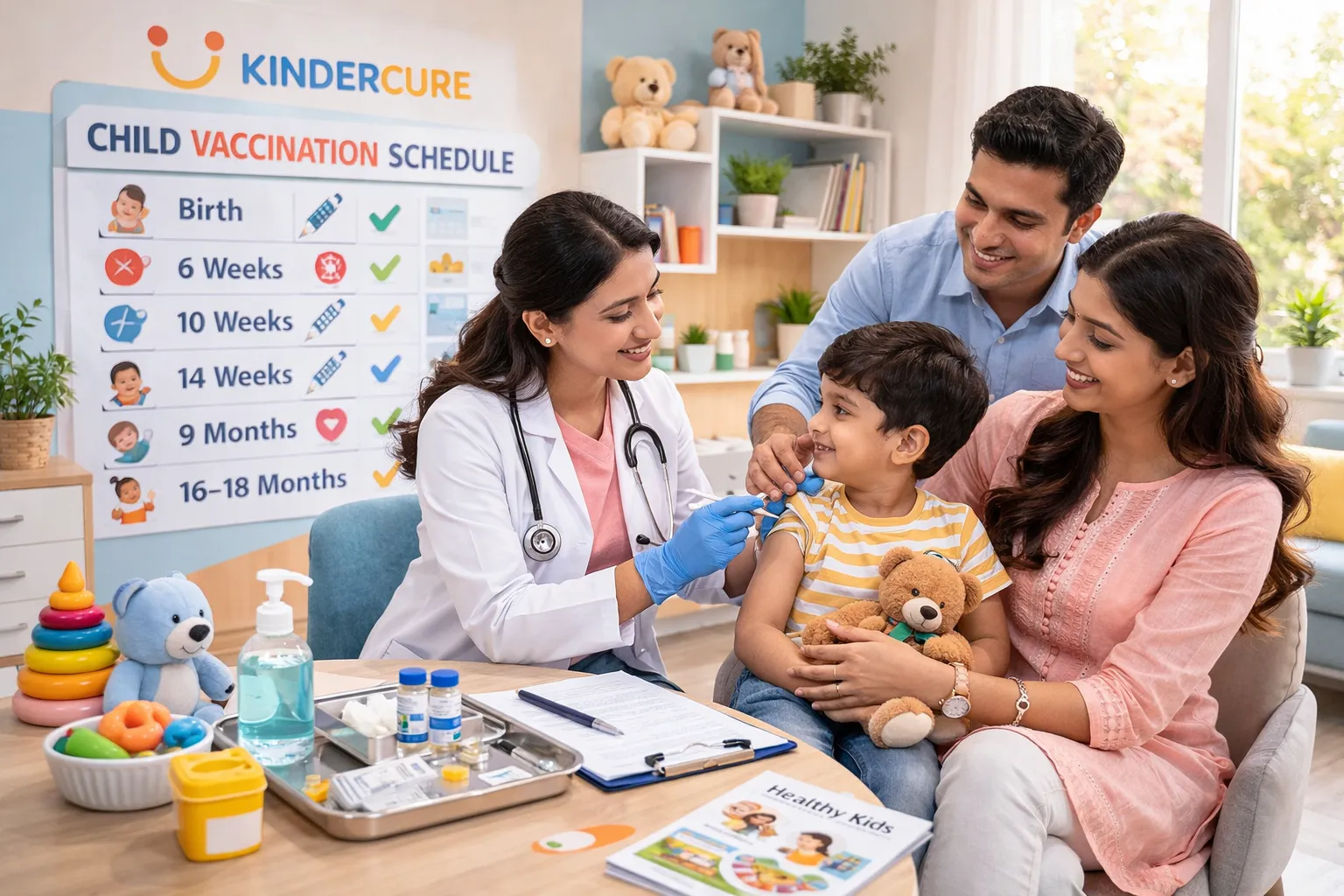
Vaccination is the single most effective public health intervention available to protect children from life-threatening infectious diseases. India's immunisation landscape has evolved significantly — from the Universal Immunisation Programme (UIP) covering basic vaccines to the comprehensive schedule recommended by the Indian Academy of Pediatrics (IAP) that includes newer, highly effective vaccines.
This guide covers everything Indian parents need to know: the complete vaccination schedule from birth through adolescence, vaccine safety, optional versus essential vaccines, and the most common myths debunked with evidence.
"Vaccines are the most thoroughly tested medical products in existence. Every vaccine your child receives has been through years of clinical trials and ongoing safety monitoring. The diseases they prevent are far more dangerous than any vaccine side effect." – Dr. Garima Mengi, KinderCure Clinic
Why Vaccination Matters
The Impact of Childhood Immunisation
- India eliminated polio in 2014 — a direct result of sustained vaccination efforts
- Measles deaths in India have declined by over 80% since the introduction of the measles vaccine
- The pneumococcal vaccine (PCV) prevents an estimated 300,000 child deaths globally each year
- Rotavirus vaccination prevents the leading cause of severe diarrhoea in children under 5
How Vaccines Work
Vaccines train the immune system to recognise and fight specific pathogens without causing the disease. They work by introducing:
- Weakened (live attenuated) forms of the virus or bacteria (e.g., MMR, BCG, OPV)
- Inactivated (killed) forms (e.g., IPV, hepatitis A)
- Parts of the pathogen — proteins or sugars from the surface (e.g., PCV, Hib)
- Toxoids — inactivated toxins produced by the bacteria (e.g., tetanus, diphtheria)
- mRNA or viral vector platforms — newer technologies (not yet in routine paediatric schedules in India)
The immune system responds by producing antibodies and memory cells. If the child later encounters the actual pathogen, the immune system recognises it immediately and mounts a rapid, effective response.
For a deeper look at how immunity develops in children, see our article on boosting immunity in children.
Complete IAP Vaccination Schedule (2024-25)
The Indian Academy of Pediatrics recommends the following schedule. Vaccines listed under "IAP Recommended" are strongly recommended by pediatric experts. "Optional" vaccines provide additional protection and are recommended where affordable and available.
Birth
| Vaccine | Disease | Type |
|---|---|---|
| BCG | Tuberculosis | IAP Recommended |
| OPV-0 | Polio (oral, zero dose) | IAP Recommended |
| Hepatitis B — Birth Dose | Hepatitis B | IAP Recommended |
6 Weeks
| Vaccine | Disease | Type |
|---|---|---|
| DTwP/DTaP-1 | Diphtheria, Tetanus, Pertussis | IAP Recommended |
| IPV-1 | Polio (injectable) | IAP Recommended |
| Hib-1 | Haemophilus influenzae type b | IAP Recommended |
| Hepatitis B-2 | Hepatitis B | IAP Recommended |
| Rotavirus-1 | Rotavirus (severe diarrhoea) | IAP Recommended |
| PCV-1 | Pneumococcal disease | IAP Recommended |
10 Weeks
| Vaccine | Disease | Type |
|---|---|---|
| DTwP/DTaP-2 | Diphtheria, Tetanus, Pertussis | IAP Recommended |
| IPV-2 | Polio | IAP Recommended |
| Hib-2 | Haemophilus influenzae type b | IAP Recommended |
| Hepatitis B-3 | Hepatitis B | IAP Recommended |
| Rotavirus-2 | Rotavirus | IAP Recommended |
| PCV-2 | Pneumococcal disease | IAP Recommended |
14 Weeks
| Vaccine | Disease | Type |
|---|---|---|
| DTwP/DTaP-3 | Diphtheria, Tetanus, Pertussis | IAP Recommended |
| IPV-3 | Polio | IAP Recommended |
| Hib-3 | Haemophilus influenzae type b | IAP Recommended |
| Rotavirus-3 | Rotavirus | IAP Recommended |
| PCV-3 | Pneumococcal disease | IAP Recommended |
6 Months
| Vaccine | Disease | Type |
|---|---|---|
| OPV-1 | Polio (oral booster) | IAP Recommended |
| Influenza-1 | Influenza | IAP Recommended |
| Typhoid Conjugate (TCV) | Typhoid fever | IAP Recommended |
9 Months
| Vaccine | Disease | Type |
|---|---|---|
| OPV-2 | Polio (oral booster) | IAP Recommended |
| MMR-1 or Measles | Measles, Mumps, Rubella | IAP Recommended |
| Influenza-2 | Influenza (2nd dose) | IAP Recommended |
12 Months
| Vaccine | Disease | Type |
|---|---|---|
| Hepatitis A-1 | Hepatitis A | IAP Recommended |
| PCV Booster | Pneumococcal disease | IAP Recommended |
| Varicella-1 | Chickenpox | IAP Recommended |
15 Months
| Vaccine | Disease | Type |
|---|---|---|
| MMR-2 | Measles, Mumps, Rubella | IAP Recommended |
| Varicella-2 | Chickenpox | IAP Recommended |
16-18 Months
| Vaccine | Disease | Type |
|---|---|---|
| DTwP/DTaP Booster-1 | Diphtheria, Tetanus, Pertussis | IAP Recommended |
| IPV Booster-1 | Polio | IAP Recommended |
| Hib Booster | Haemophilus influenzae type b | IAP Recommended |
| Hepatitis A-2 | Hepatitis A (if killed vaccine used) | IAP Recommended |
2 Years
| Vaccine | Disease | Type |
|---|---|---|
| Typhoid Conjugate Booster | Typhoid fever | IAP Recommended |
| Meningococcal | Bacterial meningitis | Optional |
| Cholera (oral) | Cholera | Optional |
4-6 Years
| Vaccine | Disease | Type |
|---|---|---|
| DTwP/DTaP Booster-2 | Diphtheria, Tetanus, Pertussis | IAP Recommended |
| IPV Booster-2 | Polio | IAP Recommended |
| MMR-3 (or Varicella catch-up) | If not given previously | IAP Recommended |
9-14 Years
| Vaccine | Disease | Type |
|---|---|---|
| HPV (2 doses) | Human Papillomavirus (cancers) | IAP Recommended |
| Tdap Booster | Tetanus, Diphtheria, Pertussis | IAP Recommended |
Annual
| Vaccine | Disease | Type |
|---|---|---|
| Influenza | Seasonal influenza | IAP Recommended (annually from 6 months) |
For your child's vaccination needs, visit our child vaccination services.
Understanding Key Vaccines
The Influenza Vaccine
The influenza vaccine is unique because it needs to be given every year. Flu viruses mutate constantly, and each season's vaccine is reformulated to match the circulating strains.
Why it matters for children:
- Children under 5 are at highest risk for flu complications
- Influenza causes more school absences than any other preventable disease
- The vaccine reduces hospitalisation risk by up to 74% in children
For a detailed guide, see our article on influenza vaccines for children and tips for protecting your child during flu season.
The HPV Vaccine
Human Papillomavirus (HPV) causes cervical cancer (the second most common cancer in Indian women), as well as throat, anal, and penile cancers. The HPV vaccine is one of the most effective cancer prevention tools available.
Key facts:
- Recommended for both boys and girls
- Most effective when given at ages 9-14 (before exposure to HPV)
- Two doses are sufficient when started before age 15; three doses needed after 15
- The vaccine has been administered to hundreds of millions of adolescents with an excellent safety record
For a comprehensive guide, see our article on the HPV vaccine for Indian parents and visit our HPV vaccination services.
RSV Immunisation
Respiratory syncytial virus (RSV) is the leading cause of bronchiolitis and pneumonia in infants. Newer immunisation options (monoclonal antibodies like nirsevimab) are now available to protect young infants during their most vulnerable months.
Visit our RSV immunisation page for the latest information.
Newborn Vaccines
The vaccines given at birth (BCG, OPV-0, Hepatitis B) provide early protection against tuberculosis, polio, and hepatitis B — all diseases with significant prevalence in India.
For more on the vaccines your newborn receives in the first days of life, see our newborn vaccines page.
Vaccine Safety: What the Evidence Shows
How Vaccines Are Tested
Before any vaccine reaches your child, it undergoes:
- Preclinical studies: Laboratory and animal testing (2-4 years)
- Phase I clinical trials: Small group (20-100 adults) to assess safety and dosing
- Phase II trials: Larger group (hundreds) to evaluate efficacy and side effects
- Phase III trials: Large-scale (thousands to tens of thousands) to confirm effectiveness and monitor for rare side effects
- Regulatory review: Approval by national regulatory authorities (CDSCO in India, FDA in the US, EMA in Europe)
- Phase IV (post-marketing surveillance): Ongoing monitoring after approval — this never ends
This process typically takes 10-15 years and involves thousands of participants before a vaccine is approved for children.
Common Side Effects (Normal)
Most vaccine side effects are mild, short-lived, and a sign that the immune system is responding:
- Pain, redness, or swelling at injection site — resolves in 1-2 days
- Low-grade fever (37.5-38.5°C) — common in the first 24-48 hours
- Fussiness or irritability — especially in young infants
- Mild rash — occasionally seen with MMR and varicella vaccines
- Decreased appetite — temporary, resolves within a day
When to Contact Your Doctor After Vaccination
- Fever above 39°C (102.2°F) persisting beyond 48 hours
- Swelling or redness at the injection site that increases after 24 hours
- Unusual, inconsolable crying lasting more than 3 hours
- Allergic reaction (rare): hives, swelling of face/throat, difficulty breathing — seek emergency care
Serious Side Effects (Extremely Rare)
Severe adverse reactions to vaccines are exceedingly rare (approximately 1 in 500,000 to 1 in 1,000,000 doses). The risk of serious complications from the diseases vaccines prevent is orders of magnitude higher.
"I have vaccinated thousands of children in my career. I have seen mild fevers and sore arms. I have never seen a serious vaccine adverse event. What I have seen — before vaccines were widely available — were children hospitalised with measles encephalitis, pertussis, and invasive pneumococcal disease." – Dr. Garima Mengi
DTwP vs DTaP: Understanding the Choice
Indian parents often face the choice between DTwP (whole-cell pertussis) and DTaP (acellular pertussis):
| Factor | DTwP | DTaP |
|---|---|---|
| Efficacy | High | High |
| Side effects | More local reactions (pain, swelling), higher fever risk | Fewer side effects, better tolerated |
| Cost | Lower (included in government programme) | Higher (typically INR 1,500-2,500 per dose) |
| Availability | Government hospitals, most private clinics | Private clinics |
| IAP recommendation | Acceptable | Preferred for children with previous severe reactions to DTwP |
Both provide excellent protection. Discuss with your pediatrician which is appropriate for your child.
Government vs Private Vaccination: What Is the Difference?
Universal Immunisation Programme (UIP)
India's government programme provides free vaccination at government health centres. The UIP covers:
- BCG, OPV, Hepatitis B, Pentavalent (DPT + Hib + Hep B), Measles-Rubella, Rotavirus, PCV, IPV
Private Vaccination
Private clinics offer the same vaccines plus additional options:
- DTaP (instead of DTwP)
- Varicella (chickenpox)
- Hepatitis A
- Typhoid conjugate
- Influenza (annual)
- HPV
- Meningococcal
The choice between government and private vaccination is primarily one of availability and access to optional vaccines. Both settings provide safe, effective immunisation.
Common Vaccination Myths Debunked
"Vaccines cause autism"
This myth originated from a 1998 study by Andrew Wakefield, which was retracted by The Lancet in 2010 after it was found to be fraudulent. The researcher lost his medical licence. Since then, multiple large-scale studies involving millions of children have found no link between vaccines and autism [1].
"Natural immunity is better than vaccine immunity"
Natural immunity does develop after surviving a disease, but at the cost of illness — which can include hospitalisation, permanent disability, or death. Vaccines provide immunity without the risk of the disease.
"Too many vaccines overwhelm a child's immune system"
A child's immune system encounters thousands of antigens daily from food, dust, and normal bacteria. The total antigen load from all childhood vaccines combined is a tiny fraction of what the immune system handles routinely [2].
"My child does not need vaccines because other children are vaccinated"
Herd immunity protects those who genuinely cannot be vaccinated (immunocompromised children, infants too young for certain vaccines). It is not a reason to avoid vaccination for healthy children. When vaccination rates drop below threshold levels, outbreaks occur — as seen with measles outbreaks globally when vaccination rates declined.
"Vaccines contain dangerous chemicals"
Vaccine ingredients (adjuvants, preservatives, stabilisers) are present in minute quantities and have been extensively studied. The amount of aluminium in a vaccine, for example, is less than what a baby ingests from breast milk in a single day. Thimerosal (a mercury-based preservative) has been removed from most paediatric vaccines since 2001, though studies showed no safety concerns at the levels used.
Managing Vaccination Day
Before the Visit
- Ensure your child is generally well (mild cold without fever is usually fine)
- Bring the vaccination record book
- Dress your child in loose, comfortable clothing
- For infants, plan to breastfeed during or immediately after vaccination (natural pain relief)
During Vaccination
- Hold your child securely and provide comfort
- Distraction techniques (singing, toys, videos) help older infants and toddlers
- Stay calm — children pick up on parental anxiety
After Vaccination
- Observe in the clinic for 15-30 minutes (standard precaution for rare allergic reactions)
- Paracetamol can be given for fever or pain if recommended by your doctor
- A cool, damp cloth on the injection site can relieve soreness
- Keep a record of the vaccination given, lot number, and any side effects
Catch-Up Vaccination
If your child has missed vaccines, it is almost never too late to catch up. Your pediatrician can create a personalised catch-up schedule based on your child's age and vaccination history. The IAP provides detailed catch-up guidelines for every vaccine in the schedule.
For complete immunisation history review and catch-up planning, see our article on the importance of childhood immunisations.
Protect Your Child with Complete Vaccination
At KinderCure Clinic, Dr. Garima Mengi provides comprehensive vaccination services including both IAP-recommended and optional vaccines, with detailed counselling for parents. Whether your child needs routine immunisation, catch-up vaccines, or the annual flu shot, we are here to help. Book a vaccination appointment today.
Frequently Asked Questions
Can my child get vaccinated if they have a mild cold?
Yes. A mild cold, runny nose, or low-grade fever is not a reason to delay vaccination. Vaccines are only postponed for moderate-to-severe illness with high fever. Delaying vaccines due to mild illness leaves your child unprotected unnecessarily.
How many vaccines can be given at one visit?
Multiple vaccines can safely be given at the same visit. Combination vaccines (like pentavalent, which combines 5 vaccines in one injection) reduce the number of shots needed. There is no evidence that multiple vaccines at one visit are less safe or less effective than spacing them out.
What is the cost of complete childhood vaccination in India?
Government programme vaccines are free. The full IAP-recommended schedule through private clinics costs approximately INR 25,000-40,000 from birth to 2 years (depending on the specific vaccines chosen — DTaP vs DTwP, combination vs individual vaccines). HPV vaccination adds approximately INR 5,000-8,000.
Are combination vaccines safe?
Yes. Combination vaccines (hexavalent, pentavalent, tetravalent) undergo the same rigorous testing as individual vaccines. They reduce the number of injections, the number of clinic visits, and the overall stress for children and parents — with equivalent safety and efficacy.
Can adults get vaccinated at KinderCure?
While KinderCure primarily serves children and adolescents, we provide guidance on adult vaccination needs, particularly for new parents (Tdap booster, influenza) and caregivers in contact with young infants.
Related Articles
- Child Vaccination Services at KinderCure
- Influenza Vaccine Guide for Children
- HPV Vaccine: A Guide for Indian Parents
- How to Protect Your Child in Flu Season
- Importance of Childhood Immunisations
References
[1] Taylor LE, Swerdfeger AL, Eslick GD. "Vaccines are not associated with autism: An evidence-based meta-analysis of case-control and cohort studies." Vaccine, 2014; 32(29): 3623-3629.
[2] Offit PA, Quarles J, Gerber MA, et al. "Addressing parents' concerns: Do multiple vaccines overwhelm or weaken the infant's immune system?" Pediatrics, 2002; 109(1): 124-129.
[3] Indian Academy of Pediatrics. "IAP Advisory Committee on Vaccines and Immunization Practices (ACVIP) Recommended Immunization Schedule 2024-25." Indian Pediatrics, 2024.
Related Articles


Protect Your Child with Timely Vaccinations
Schedule your child's vaccination with Dr. Garima Mengi at KinderCure.